Coffee, Silence, and a Professor Who Refused to Become a Problem
The good news is that I arrived in Budapest alive.
The more surprising news is that I arrived rested.
These two conditions do not often occur together.
I remember the train leaving Lviv. I remember arranging myself inside the narrow bed with the careful geometry of a man folding himself into an envelope. I remember deciding that I would remain awake for the border, the customs inspection, the change of wheels, and any other international procedure involving uniforms, documents, or the physical lifting of my sleeping compartment into the air.
Then I closed my eyes for what I believed would be three minutes.
Somewhere during the night, someone knocked on the compartment door.
I opened one eye.
A border guard stood outside.
He requested my passport. I gave it to him with the solemn dignity of a man who had no idea which country he was currently in. He examined it, examined me, and appeared satisfied that the exhausted object lying under the railway blanket was indeed the same exhausted object pictured in the document.
I considered sitting up.
Instead, I said thank you, placed my head back on the pillow, and immediately returned to sleep.
This was not carelessness. It was trust in European administrative procedure.
Or unconsciousness.
The distinction is philosophical.
At some point, the train’s wheels were changed to fit the narrower European tracks. This normally involves hydraulic equipment, heavy machinery, metallic impacts, and the entire carriage being lifted while passengers remain inside it.
I slept through it.
Apparently, there was grinding beneath us. There were bangs. The carriage moved in ways that should have persuaded every mammal inside it to wake and reconsider its life.
Nothing.
I have been awakened by a pigeon landing too confidently on a windowsill, yet I remained asleep while railway workers replaced the train beneath me.
This may be the finest achievement of my career.
When I finally woke, the landscape outside had changed. The light was brighter, the fields looked suspiciously Hungarian, and my passport had somehow returned to the little table beside the bed.
Nobody had arrested me.
Nobody had asked about the devices in my bag.
Nobody had opened a dimensional customs declaration and demanded that I list every reality visited during the previous ninety days.
A successful border crossing.
The train arrived in Budapest late in the morning.
I stepped onto the platform feeling unexpectedly human. Not elegant, exactly. Night trains rarely produce elegance. They produce a particular traveller who is technically dressed but still looks as if he has recently been assembled from spare blankets.
Still, I had slept.
The professor had not called.
This was the first suspicious thing.
His original message had created the impression that Budapest contained a problem requiring my immediate presence, unusual experience, and possibly resistance to temporal decomposition. He had written with academic urgency, which means several polite paragraphs designed to conceal the fact that something nearby has started whispering in Latin.
Yet now that I was here, silence.
No missed calls.
No message.
No frantic instruction to avoid bridges, mirrors, museum basements, or anyone carrying an umbrella indoors.
I sent him a brief message.
Arrived in Budapest. Call when ready.
Then I waited for the reassuring little sign that he had read it.
Nothing.
Perhaps he was teaching.
Perhaps he was examining the anomaly.
Perhaps the anomaly was examining him.
There was no point speculating before coffee.
I left my luggage at the Mercure Budapest City Center Hotel, where I had booked a room for the simple and professionally defensible reason of: why not?
There are moments when a responsible traveller chooses practical accommodation near the railway station.
There are other moments when an immortal wanderer who has slept inside abandoned observatories, cargo holds, monastery cellars, border waiting rooms, and one aggressively damp lighthouse decides he deserves a comfortable hotel directly on Váci Street.
This was the second kind of moment.
The hotel stood in the middle of central Budapest, surrounded by shops, restaurants, tourists, polished windows, and people walking with the confidence of those whose professors had not summoned them internationally and then disappeared.
The receptionist took my luggage without asking whether it contained unstable technology from outside conventional spacetime.
Excellent service.
Check-in would be later. Until then, I needed breakfast.
Or lunch.
The exact category had become unclear.
Fortunately, coffee does not recognize administrative divisions between meals.
I walked to Kontakt.
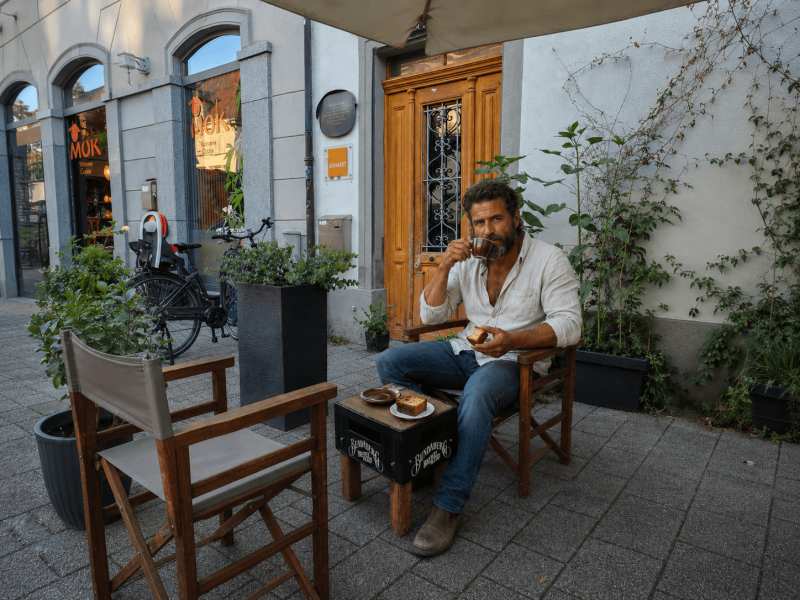
Kontakt hides in a passage off Károly körút, which is precisely where a serious coffee shop should hide. Not invisible, but discreet. The sort of place you discover either through research, recommendation, or by following someone who looks disappointingly well rested.
The passage separated it from the noise of the main road. Budapest remained only a few steps away, with its traffic, trams, grand buildings, tourists, office workers, and general metropolitan activity, but inside the courtyard everything narrowed toward coffee.
Kontakt was small, clean, and minimalist without feeling sterile. Pale wood, dark surfaces, serious equipment, bags of beans, cups arranged with the calm precision of laboratory instruments.
There are cafés designed for photographs.
Kontakt appeared to have been designed for the dangerous belief that coffee matters.
I approved immediately.
The person behind the counter asked what I wanted.
This was an unreasonable question to ask a man who had just crossed an international border inside a sleeping carriage.
I began with a flat white.
The first sip restored basic diplomatic relations between my brain and the rest of my body.
The coffee was balanced, sweet without needing sugar, and properly textured. No giant cup of boiling milk hiding a frightened espresso somewhere at the bottom. It tasted deliberate.
I sat down, checked my phone, and found no response from the professor.
I checked the time.
Perhaps he was busy.
Perhaps he had forgotten which Monday we had agreed upon.
This has happened before with academics and, on one occasion, a seventeenth-century astronomer who was using a calendar no longer recognized by three major religions.
Food arrived next.
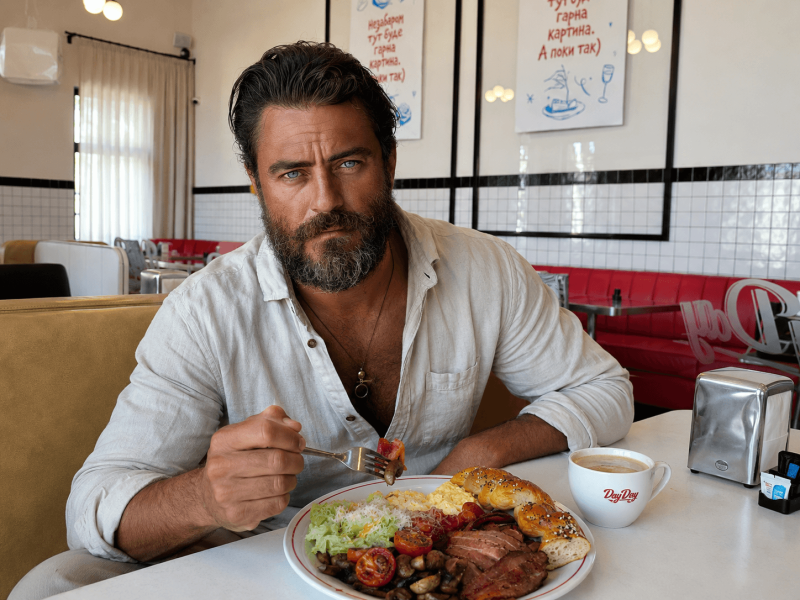
Avocado toast, because I had already eaten enough meat in Lviv to concern several regional ecosystems.
The bread was crisp at the edges and substantial enough to survive the avocado rather than dissolving beneath it. The avocado was creamy, fresh, lightly seasoned, and accompanied by egg and greens. It was the sort of breakfast that suggests the person eating it owns exercise clothes.
I do own exercise clothes.
They are excellent for packing around fragile objects.
I ate slowly, watched people come and go, and tried not to stare at my phone every thirty seconds.
The professor still had not called.
This was now the second suspicious thing.
Professors are rarely early, but they are usually eager to explain why their emergency is more interesting than whatever you were doing before it became your emergency.
I ordered a filter coffee.
The barista discussed the available beans with the seriousness of someone helping me select a route through a mountain range. I chose one with bright fruit notes, partly because it sounded good and partly because selecting coffee by flavour description is much more pleasant than selecting realities by extinction probability.
The filter arrived clear and aromatic.
I let it cool.
This is important. Drinking filter coffee immediately is like questioning a witness while they are still on fire. You may receive information, but it will not be the best information.
As it cooled, the coffee opened into fruit, gentle acidity, sweetness, and the faint realization that I could happily spend the entire day here pretending to work.
I opened my notebook.
At the top of a blank page, I wrote:
BUDAPEST PROFESSOR SITUATION
Below it:
Current facts:
Professor requested my presence. I am present. Professor is not.
It was already one of my more complete investigations.
I checked the Brama device inside my bag. Dormant.
Laminas showed no local dimensional instability.
My phone had a signal.
The courtyard contained no figures standing unnaturally still.
A small dog passed the entrance and behaved like a normal dog rather than an emissary.
Everything appeared ordinary.
I did not like it.
I ordered banana bread.
This was partly hunger and partly operational necessity. You should never investigate the disappearance of a professor with low blood sugar. It leads to bad decisions, unnecessary heroism, and vending-machine dinners.
The banana bread was dense, moist, and exactly sweet enough. It did not attempt to reinvent itself as architecture. It did not arrive under smoke or balanced vertically against a spoon. It was simply good banana bread, which is one of the most reliable forms of civilization.
I ate it with the remainder of the filter coffee.
The professor remained silent.
Kontakt also serves a cold coffee called Roket, poured from a tap.
Naturally, I ordered one.
A tapped cold coffee sounds like something developed either by extremely competent baristas or a small experimental weapons division. In this case, fortunately, it was the baristas.
It arrived dark, cold, and smooth, with the visual authority of a drink that might contain classified information.
Three coffees after leaving a night train is not excessive.
Three coffees is a committee.
The flat white had restored basic function.
The filter had restored curiosity.
The Roket restored my willingness to interpret the professor’s silence as an opportunity rather than a warning.
By then, breakfast had become lunch, or lunch had successfully annexed breakfast. I had been in Budapest for several hours. My luggage was at a comfortable hotel. I was fed. I was caffeinated. I had crossed the border while barely conscious and survived the train being physically reconfigured beneath me.
And the professor, whose urgent invitation had brought me here, had apparently decided not to participate.
I sent a second message.
I am at Kontakt. I will remain available, but unless I hear from you soon, I am becoming a tourist.
This was not a threat.
It was a boundary.
A man cannot remain indefinitely in professional suspense while surrounded by one of Europe’s most beautiful cities.
Outside the passage, Budapest was waiting.
The city had that late-morning brightness which makes every building look freshly introduced. Yellow trams moved past grand façades. People crossed streets with coffee cups and shopping bags. Somewhere beyond the rooftops, the Danube divided the city with the dramatic confidence of a river that knows it will appear in every photograph.
I looked at my phone one final time.
Nothing.
Very well.
I returned to the Mercure, collected my key, and went upstairs.
The room was modern, quiet, and far more comfortable than the narrow shelf on which I had crossed the border. There was a proper bed, a clean bathroom, a desk, and a window looking toward the compressed energy of central Budapest.
I placed the Brama device in the safe.
Then I removed it from the safe because hotel safes are designed for passports, jewellery, and perhaps emergency cash, not machinery capable of opening a doorway into a place where the laws of causality are locally optional.
I put it inside the wardrobe instead.
Much safer.
I showered, changed clothes, and briefly lay down on the bed.
This was dangerous.
A comfortable hotel bed after a night train has the gravitational force of a small planet.
But I had slept. Miraculously, impossibly, I had slept through passports, borders, railway engineering, and the train being lifted into the air. I had no excuse to waste Budapest unconscious.
The professor had until two o’clock.
At two o’clock exactly, I checked my phone.
No call.
No message.
No academic apology.
No photograph of an impossible object beside a ruler for scale.
No panicked voice note interrupted by chanting.
Nothing.
I stood beside the window and made my decision.
Today, I would be a tourist.
This is a role I rarely perform intentionally. Usually, I arrive in a city as a traveller, investigator, courier, witness, accidental suspect, or person fleeing a building whose geometry has become argumentative.
Tourist was new.
Tourists look at landmarks without checking whether they are dimensional anchors.
They cross bridges for the view rather than because something has escaped beneath one.
They enter museums through the main door.
They photograph statues instead of comparing them with wanted notices from other centuries.
I believed I could do it.
I packed only the essentials: phone, wallet, notebook, sunglasses, and one device small enough to conceal but powerful enough to extract me if Budapest stopped behaving geographically.
Responsible tourism.
Before leaving, I sent the professor one last message.
I am going out. You know how to reach me. Unless the city folds in half, this is now my day off.
Then I stepped onto Váci Street.
Budapest opened around me in stone, sunlight, shop windows, street noise, and the distant promise of the river.
For once, nobody was waiting with a secret file.
No one whispered my name from an alley.
No pigeon attempted to deliver a coded message.
No cash machine abducted me.
Not yet.
I had a hotel room in the centre, several coffees moving through my bloodstream, an absent professor, and an entire afternoon with no official purpose.
It was an unfamiliar sensation.
Freedom often is.
I turned toward the Danube.
Behind me, inside my pocket, the phone remained silent.
Ahead of me, Budapest waited like a city.
Just a city.
Beautiful, complicated, historic, alive, and completely innocent of whatever the professor wanted.
I decided to enjoy that belief for as long as it lasted.