The Book That Was Not There
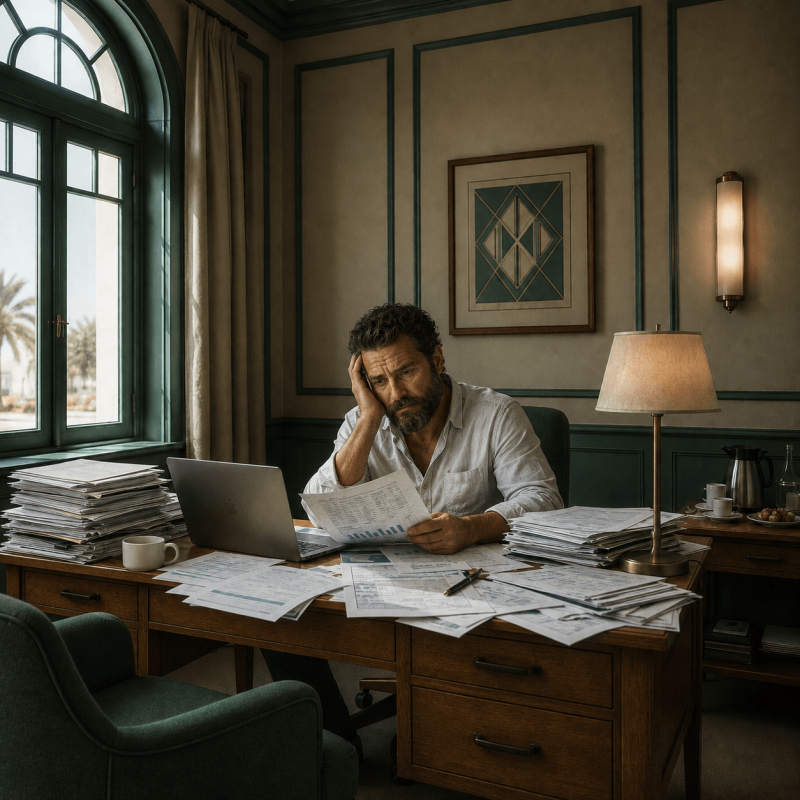
The professor still had not called.
By Tuesday morning, this had ceased to be mildly inconvenient and had become professionally suspicious.
I woke in my hotel room shortly after eight, checked my phone, checked it again in case the first inspection had somehow been conducted in the wrong reality, and found nothing.
No message from Professor Dániel Kőszegi.
No missed call.
No apology.
No photograph of an artefact beside a ruler.
No final voice recording beginning with the words, “Marco, whatever you do, do not…”
Only silence.
I made coffee using the machine in the room.
Hotel coffee is not necessarily bad. It is simply coffee that has accepted a government position and no longer takes risks.
I drank it beside the window and watched Váci Street begin its day below me. Delivery vans stopped in impossible places. Shop employees raised shutters. Tourists emerged holding maps as if Budapest had personally challenged them to a duel.
Professor Kőszegi remained missing.
At nine seventeen, my phone rang.
The number was Hungarian.
I answered.
“Marco?”
The man pronounced my name cautiously, as though testing whether it might activate something.
“Yes.”
“My name is Professor Áron Váradi. I work with Professor Kőszegi.”
There was a pause after the name.
Not a normal pause.
It was the kind of pause people use when deciding whether to say is missing, has disappeared, or may have been consumed by his research.
“Have you heard from him?” I asked.
“No. That is why I am calling.”
Professor Váradi explained that he and Kőszegi had been collaborating on a newly recovered medieval manuscript. Kőszegi had missed two meetings on Monday, had not returned home, and had failed to answer calls from the university, his family, or the police.
His office had been checked.
His apartment had been checked.
The excavation site had been checked.
His car remained where he had left it on Sunday.
“Why are you calling me?” I asked.
“Because your name was written on his desk calendar.”
“That is not especially strange. He invited me to Budapest.”
“Under your name he wrote, ‘He will understand the second book.’”
I looked across the room toward the wardrobe.
The Brama and Laminas were inside.
I had not told Professor Kőszegi about either of them.
“Where are you?” I asked.
“At the university. Múzeum körút.”
“I will be there in thirty minutes.”
“You know the campus?”
“No.”
“Then perhaps forty.”
“I know Budapest has trams. Thirty-five.”
I dressed, placed the Brama and Laminas in my bag, reconsidered carrying both through central Budapest, then remembered that a professor had disappeared after writing about a second book.
I carried both.
The Trefort Garden campus of Eötvös Loránd University stood near Astoria, hidden behind the movement of the boulevard.
It was not medieval, despite what the word university encourages tourists to imagine. There were no monks crossing the courtyard carrying chained books. Nobody was debating Aristotle beneath a torch while plague bells rang in the distance.
Instead, the campus consisted of dignified old buildings in several architectural styles gathered around a garden, as though different centuries had agreed to share an address but not an opinion.
Stone stairs had been worn slightly lower in the middle by generations of students. Tall windows caught the morning light. Corridors smelled of old paper, floor polish, coffee, and the particular dust produced when academics move books from one shelf to another without ever throwing anything away.
Professor Áron Váradi waited beside the entrance to the archaeology building.
He was in his early fifties, thin, carefully dressed, and visibly operating on very little sleep. His glasses had rectangular frames. His hair had reached the stage where it had stopped cooperating with combs and begun expressing independent scholarly judgment.
He shook my hand.
“You came quickly.”
“I was already in Budapest.”
“Yes. Dániel mentioned that he had asked you to come.”
“Unfortunately, he neglected the part where he explained why.”
Váradi looked around the courtyard before answering.
“Come inside.”
His office contained books in every direction except the floor, and even the floor appeared to be under negotiation.
He cleared two chairs by moving a stack of excavation reports onto a third.
There was coffee on the desk.
Real coffee.
This improved the credibility of the institution considerably.
“Tell me exactly what you were working on,” I said.
Professor Váradi opened a folder and removed several high-resolution photographs.
“The manuscript was found during conservation work on Castle Hill. Near one of the medieval retaining walls below the former royal palace.”
“Found how?”
“Not in a chamber. The newspapers always call these things secret chambers. It was a narrow sealed recess between two phases of masonry. Barely large enough for the container.”
The container had been a simple oak box wrapped in degraded textile and protected by layers of waxed leather. Moisture had entered, but not enough to destroy the contents.
Inside was a codex.
Its covers were made from thin oak boards beneath darkened calfskin. One iron clasp survived. Most of the text had been written in Latin on parchment, though several later pages were early rag paper. Notes appeared in other hands, some German, some Hungarian, and some in a shorthand that neither professor had identified.
The book was not a royal chronicle.
It was not a theological work.
It was not a tax record, which immediately made it less common than most surviving documents.
The principal author appeared to have been a minor clerk named Miklós, attached to the household of a customs official in Buda near the end of the fourteenth century.
Professor Váradi placed one photograph in front of me.
A heading had been written in faded red ink.
DE MARCO PEREGRINO, QUI BIS MORTUUS EST
I read it twice.
Professor Váradi watched my face.
“You understand Latin?”
“Enough.”
“Then you know what it says.”
“Of Marco the Traveller, Who Died Twice.”
“Yes.”
I grunted.
This was not the reaction Váradi expected.
“You do not appear surprised.”
“I am surprised.”
“You grunted.”
“I am surprised in an experienced way.”
He studied me for several seconds.
Then he slowly turned over another photograph.
The page contained a drawing.
It was not a portrait in the modern sense. The figure was small and awkwardly proportioned, placed beside a wall and a group of men carrying buckets. The artist had given him strange narrow trousers, a short coat, and boots unlike those worn by the others.
Above the figure was a label.
MARCUS PEREGRINUS
The face consisted of six lines and a nose.
It still looked annoyingly like me.
Professor Váradi leaned forward.
“Dániel found a photograph of you online.”
“I am sorry to hear that.”
“He believed there was a resemblance.”
“Six lines and a nose resemble many people.”
“The text describes a foreign man with dark hair, an unusual accent, clothing made from material the author could not identify, and a small metal object which produced light without flame.”
I looked at the photograph again.
My memory had already begun arranging itself into the correct century.
“Oh,” I said.
Professor Váradi removed his glasses.
“You know this manuscript.”
“No.”
“But you know the events.”
“Unfortunately.”
It had happened four years earlier.
Four years from my perspective, at least.
Time becomes difficult to describe once death begins using it as a transport system.
I had been in another reality, inside a transit station beneath a city which no longer exists. The station collapsed during an evacuation. A ceiling beam struck me before I reached the exit.
I died.
This is normally the least complicated part.
Then I woke beneath Castle Hill in the year 1391.
I was lying in a drainage trench.
It was raining.
Two labourers stood over me holding shovels and debating whether I was a foreign spy, a demon, or an especially badly dressed corpse.
I spent nineteen days in medieval Buda.
The chronicler apparently remembered them more kindly than I did.
The problem had involved a storage building near the palace works. Someone had placed lamp oil, pitch, timber, and several barrels of black powder close enough together to demonstrate that safety regulations are one of civilization’s greatest inventions.
A fire began during the night.
It spread behind a recently constructed wall, where nobody could reach it. Had it reached the powder, it would have destroyed the storehouse, part of the kitchen complex, several adjoining structures, and a section of the slope below.
I knew there was a cistern above it because I had fallen into the inspection channel two days earlier.
This is how many great discoveries happen.
I broke the sluice gate.
More accurately, I persuaded several men to help me break the sluice gate by shouting in poor Latin and pointing at the smoke.
The water flooded the burning structure.
It also entered the palace kitchens, destroyed preparations for a feast, carried two tables into the courtyard, and caused a secondary failure in the drainage system serving the royal privies.
The chronicler described this last event using the phrase a brown judgment from beneath the earth.
I had forgotten that part.
Professor Váradi had not.
He had translated the section.
“You saved forty-three people,” he said.
“Apparently.”
“You prevented a large fire.”
“Yes.”
“You also caused the contents of a latrine to emerge during the arrival of a noble delegation.”
“In my defence, the delegation survived.”
“The manuscript says one baron demanded your execution.”
“He was standing in the wrong part of the courtyard.”
“What happened after that?”
“A damaged arch collapsed. There was an apprentice beneath it. I pushed him away.”
“And?”
“The stonework landed on me.”
Professor Váradi said nothing.
“I died again,” I continued. “Then I woke in my own time, inside the remains of the transit station where I had died the first time.”
The professor put his glasses back on.
He looked at the manuscript photographs.
Then at me.
Then at the photographs again.
“Dániel believed the story described you.”
“Dániel was correct.”
“You say that very calmly.”
“I have had several years to process the royal privy.”
Váradi turned to another page.
“The manuscript says your body was placed in a chapel overnight. In the morning, it had vanished.”
“That also happens.”
“The author considered you either a saint or a warning.”
“Both are respectable career outcomes.”
I continued reading the translation.
The clerk Miklós had written down every rumour about me. Some were accurate. Some involved miracles I had not performed. One claimed I could speak to iron. Another claimed I had arrived from a kingdom beyond the setting sun where men travelled inside metal serpents.
That was not entirely wrong.
The account ended with a prayer that Marcus Peregrinus would never return, except in a moment of great need, and preferably with better control over water.
“I had no idea anyone wrote a book,” I said.
“It may be the only surviving copy.”
“I am glad they did not build a gold statue.”
Professor Váradi almost smiled.
“Because you dislike statues?”
“Because the sculptor would have needed to include the latrine.”
The smile disappeared as quickly as it had appeared.
None of this explained why Professor Kőszegi was missing.
“When did he last handle the manuscript?” I asked.
“Sunday afternoon. We worked in the conservation room until five. The book remained there when we left.”
“You left together?”
“We left the room together. I went home. Dániel returned to his office.”
“Why?”
“He said there was something in the binding he wanted to check against the scans.”
“What thing?”
“He would not explain. He asked whether I had ever encountered a book whose number of pages changed.”
I looked at him.
“And you waited until now to mention that?”
“I work with medieval manuscripts. Their foliation is often inconsistent.”
“Did he say the pages were numbered incorrectly?”
“No. He said the number changed.”
That was different.
“Show me the original.”
The visible codex remained in a controlled conservation room elsewhere in the building.
We examined it without touching it.
The manuscript rested in a support cradle beneath filtered light. Its cover was warped. Its pages were stained and uneven. It looked fragile, ancient, and entirely ordinary.
The Laminas disagreed.
I had concealed the device inside a tablet case. Professor Váradi watched as I passed it slowly over the exterior of the glass cabinet.
“What does that measure?” he whispered.
“Layers.”
“Layers of what?”
“Yes.”
The visible manuscript occupied the correct position in physical space. Its parchment matched the surrounding timeline. The ink had accumulated history normally. The boards had once been part of two oak trees cut several years apart.
There was no anomaly.
I checked the Brama.
No active passage.
No dimensional breach.
No residual gate signature.
Whatever had happened to Professor Kőszegi had not happened here.
“His office,” I said.
“The police searched it.”
“The police were looking for a professor.”
“What are we looking for?”
“A book that may not currently believe it exists.”
Professor Kőszegi’s cabinet was on the second floor.
The police had sealed the office after their first examination, but Professor Váradi had authorization from the department and permission to retrieve materials. A university administrator accompanied us, unlocked the door, reminded us not to disturb anything, and left after receiving a phone call which sounded more important than two men entering the office of a missing colleague.
The room was small and meticulously organized.
Bookshelves covered one wall. Excavation maps covered another. A desk faced the window. Several pencils had been arranged beside a closed notebook.
Professor Kőszegi’s coat hung behind the door.
His computer remained on the desk.
His glasses were beside the keyboard.
People who leave voluntarily usually take at least one of these things.
I activated the Laminas.
At first, it showed nothing unusual.
Then I changed the temporal depth.
The room divided into faint overlapping versions of itself.
The desk as it had been an hour earlier.
The shelves before the police search.
A chair in three slightly different positions.
Dust disturbed by shoes.
Heat fading from electronics.
And something rectangular on the floor beside the cabinet.
It had no colour.
It had no temperature.
It cast no shadow.
It did not appear on the Laminas display as an object. It appeared as a refusal, a book-sized section of the room from which information had been removed.
I moved the device.
The absence remained.
“There,” I said.
Professor Váradi looked at the empty carpet.
“There is nothing there.”
“Exactly.”
I set the Brama on the desk.
The Brama is designed to open routes between compatible locations. Used carefully, it can also persuade two overlapping versions of the same location to acknowledge each other.
Used carelessly, it can remove a wall from the architectural history of a building.
I had done that once.
The wall was eventually returned.
Mostly.
I placed one of the manuscript photographs on the carpet beside the invisible rectangle.
Professor Váradi watched me connect the Brama to the Laminas.
“What are you doing?”
“I am giving reality an example.”
“An example of what?”
“A book.”
The Brama emitted a quiet tone.
A line of pale light appeared across the carpet.
It passed through the empty space, stopped, and bent around something that neither of us could see.
Professor Váradi stepped back.
The outline was unmistakable.
A closed codex.
It was larger than the manuscript in the conservation room and much thicker.
I adjusted the Laminas until the outline sharpened.
For one second, the office became completely silent.
Not quiet.
Silent.
The traffic outside vanished. The ventilation stopped. Even the building’s small movements ceased.
Then a book struck the floor.
It appeared all at once.
Black leather.
Metal corners.
No title.
The impact was followed by a second, heavier sound.
Professor Dániel Kőszegi appeared beside it.
He lay on his side between the cabinet and the desk, one arm folded beneath him. His clothes were the same ones visible in the university’s security footage from Sunday.
Professor Váradi said his name once.
Then again.
I knelt, although I already knew.
There was no pulse.
His skin was cold.
I did not move him.
Across his hands, throat, and the visible part of his face ran lines of dark writing.
The marks were not cuts.
They were not drawn on the surface.
The symbols appeared beneath the skin, as though the professor had been written upon from inside.
Professor Váradi stood completely still.
“What language is that?”
“I do not know.”
“You said you had seen things like this.”
“I have seen many things. That is not the same as wanting to see them again.”
I photographed the symbols without touching the body and sent the images through an encrypted Clovis channel.
Then I called university security.
Security called the police.
The police called more police.
Within twenty minutes, the corridor was closed. Within forty, the room contained forensic officers, investigators, photographers, a medical examiner, and one university administrator who had developed the expression of a man attempting to calculate whether this incident required a new form.
The black book had become visible to everyone.
It lay on the carpet beside Professor Kőszegi.
Nobody touched it until the hazardous materials team arrived.
This was wise.
The lead investigator asked how we had discovered the body.
I explained that I had used specialized imaging equipment to identify a previously concealed object.
He looked at the cabinet.
“There is no compartment.”
“No.”
“There is no space behind it.”
“No.”
“Where was the body?”
“In the same place it is now.”
“But it was not there when the office was searched.”
“Correct.”
He looked at me for a long time.
I gave him the Clovis contact details.
Clovis maintains legal offices, research foundations, security consultancies, heritage organizations, and several other respectable institutions whose principal purpose is explaining impossible events without using the phrase impossible event.
Two agents arrived from the Budapest field office shortly after one.
They presented credentials connecting the black book to an international cultural-property investigation and requested that the object be treated as a potential environmental and informational hazard.
The police did not enjoy this explanation.
To their credit, they accepted that a medieval-looking book appearing beside a dead professor covered in unidentified writing might require unusual precautions.
Professor Váradi and I gave statements separately.
I did not lie.
I also did not explain the complete operating principles of the Brama.
There are limits to civic honesty.
The examination continued through the afternoon.
The office was sealed.
The visible manuscript remained in conservation storage.
The black book was placed inside a containment case supplied by Clovis and transferred under police supervision.
Professor Kőszegi’s body went with the medical examiner.
His death was no longer merely a missing-person case.
I watched them take him away.
He had called me to Budapest because he believed I could help.
I had arrived Monday morning.
He had already been gone.
Immortality does not make you indifferent to death.
It makes you more familiar with its timing.
Sometimes a person dies because nobody could have saved them.
Sometimes they die because help arrived one day too late.
The difference is not always useful, but it remains.
Professor Váradi stood beside me in the courtyard after the police finally allowed us to leave.
The evening light had turned the upper windows pale gold.
Students still crossed the garden. Somewhere in another building, a lecture continued. A bicycle leaned against a railing. Two young people sat beneath a tree discussing something with the absolute seriousness available only to students and people planning revolutions.
The university had absorbed the day and continued operating.
Old institutions are good at that.
“I should go home,” Váradi said.
“You should eat.”
“I am not hungry.”
“Neither am I. That means we definitely need food.”
He looked at me.
“Is this how you respond to death?”
“No. This is how I respond to not eating since morning.”
We walked toward Király Street.
Trófea Grill occupied a central location close enough to the university to reach easily and far enough away that neither of us had to look at another academic building.
Inside, the restaurant was warm, dark, and busy. Wood, glass, metal, buffet counters, open grills, and large decorative lights created the atmosphere of a hunting lodge designed by someone who had recently discovered unlimited electricity.
The arrangement was simple.
A fixed price.
A large buffet.
Take what you want.
Return when necessary.
Civilization occasionally produces perfect systems.
Professor Váradi selected a small bowl of soup.
I took a plate.
The first plate contained stuffed cabbage, chicken paprikash, dumplings, roast duck, sausage, grilled pork, potatoes, pickled vegetables, mushrooms, and one slice of bread inserted vertically to provide structural support.
It was not a plate of food.
It was a geological formation.
The server nearest the buffet watched me carry it away.
I returned for sauce.
When I reached the table, Professor Váradi stared at the plate.
“You said you were not hungry.”
“I was mistaken.”
“You cannot possibly eat that.”
This was an understandable opinion.
It was also incorrect.
I began with the stuffed cabbage.
The food was rich, hot, and reassuringly committed to the belief that butter, meat, paprika, and sour cream can solve problems beyond the reach of ordinary diplomacy.
For several minutes, we ate without speaking.
Professor Váradi slowly finished his soup.
I finished the mountain.
The server passed our table twice.
On the second occasion, he looked at the empty plate.
Then at me.
Then back at the plate.
I returned to the buffet.
The second mountain was larger.
This time I added beef from the grill, another portion of duck, more dumplings, potatoes, a cabbage roll balanced near the summit, and several items I could not identify but trusted because they smelled of garlic.
By the time I returned, a member of the kitchen staff had appeared near the grill.
He pretended to inspect the carving station.
The hostess had also found a reason to stand near our section.
A waiter began resetting a table which had already been set.
None of them openly stared.
They simply developed an intense professional interest in the survival of the furniture around me.
Professor Váradi watched the staff gather.
“Do you always eat like this?”
“Only after dimensional incidents.”
“How frequently do those happen?”
“Often enough that I own larger trousers.”
I ate the second mountain.
The kitchen employee said something quietly to the server.
The server shook his head.
The hostess looked impressed.
I considered taking a third plate, but that would have transformed scientific curiosity into public concern.
Instead, I collected dessert.
Somlói galuska, strudel, small cakes, and fruit for moral balance.
Professor Váradi had recovered enough to eat several pieces of roast meat and some potatoes.
He looked tired, but no longer hollow.
I waited until coffee arrived.
Then I said, “Clovis could use you.”
He looked up.
“What?”
“You understand medieval manuscripts. You understand archaeological context. You remained functional after watching a book and a dead colleague appear from empty space.”
“I would not describe myself as functional.”
“You ordered soup. That demonstrates planning.”
“What exactly are you proposing?”
“Consulting work at first. Manuscripts, displaced artefacts, historical anomalies, objects found in the wrong century, texts written in languages which technically never existed here.”
“You say that as though it is a recognized academic field.”
“It is. The conferences are simply very private.”
Professor Váradi looked down at his coffee.
“Dániel would have accepted immediately.”
“I know.”
“He spent his career hoping to find something that changed the historical record.”
“He found something that belonged to a larger record.”
“And it killed him.”
“Yes.”
I did not soften it.
There was no respectful way to recruit someone into Clovis while pretending the work was safe.
“What happens to the manuscript?” he asked.
“The visible one remains evidence for now. The black book goes into containment. You would have access to both as part of the investigation.”
“That is bribery.”
“Yes.”
“Effective bribery.”
“I try to respect people’s disciplines.”
He was silent for almost a minute.
Around us, plates moved, glasses touched tables, and the buffet continued feeding Budapest.
Finally, he asked, “Would I have to leave the university?”
“No. Clovis prefers people who continue looking ordinary.”
“I am an archaeologist specializing in medieval documentary contexts.”
“That is already close enough.”
“And what would my title be?”
“We can invent something impressive.”
“I would prefer something accurate.”
“That may be more difficult.”
For the first time that day, Professor Áron Váradi laughed.
It was brief and tired, but real.
“Very well,” he said. “I accept.”
My phone vibrated.
A response had arrived from Clovis Linguistics.
The message carried a red classification marker.
PRELIMINARY IDENTIFICATION: SCRIPT FAMILY ASSOCIATED WITH THE VELIS ARCHIVE TRADITION. ESTIMATED AGE UNKNOWN. NON-TERRESTRIAL ORIGIN PROBABLE.
Below it was a partial translation of the writing found on Professor Kőszegi.
I read it once.
Then again.
Professor Váradi noticed my expression.
“What does it say?”
I placed the phone on the table between us.
The translation consisted of two lines.
THE WITNESS HAS BEEN CATALOGUED.
THE TRAVELLER’S VOLUME REMAINS OPEN.
Professor Váradi read them silently.
Then he looked at me.
“When do I begin?”
I looked toward the buffet.
Several members of staff were still watching from a respectful distance, perhaps waiting to see whether I intended to construct a third mountain.
“Apparently,” I said, “you began on Sunday.”
Outside, Budapest continued through the evening as though nothing had happened.
The trams moved.
The river passed beneath the bridges.
Castle Hill stood above the city, full of rebuilt walls, sealed spaces, old foundations, and whatever else history had decided not to surrender yet.
Somewhere inside Clovis containment, the black book waited.
It had no title.
It had no known author.
For at least one day, it had not officially existed.
And according to the writing on a dead professor, it was still reading me.