The One-Person Pizza Incident
After several days of being sick and barely eating, which for me is not so much an illness as a temporary collapse of civilization, I finally felt well enough for my first walk outside. Since returning to food after such a period requires caution, wisdom and at least the appearance of self-control, I decided to start small with a quick lunch and went to 1708 Pizza di Napoli on Krakivska Street, 1.
The restaurant is a bright little corner of old Lviv: green wooden shutters, potted plants leaning toward the windows, pale textured walls and long wooden tables designed for either six friends or one traveller carrying an unreasonable quantity of notebooks. The café specialises in Neapolitan-style “pizza for one,” which, as we shall see, was an important promise reality chose not to honour.
The address itself is older and more suspicious than the restaurant. Krakivska 1 is the historic Abrekivska townhouse. The present building was raised in 1769 over much older cellars after the previous structure had deteriorated beyond polite repair. This means that when something inexplicable happens there, one should not immediately blame the chef. There are several centuries beneath the floor with ample opportunity to become eccentric.
I sat on the green sofa beside the window and ordered one small pepperoni pizza.
“One?” the waitress asked.
“One,” I confirmed.
This exchange later became important evidence.
The pizza arrived several minutes later, warm and fragrant, with a blistered crust, melted mozzarella and little circles of pepperoni curling upward like tiny bowls designed to collect happiness. It was exactly the right size for lunch. Not too large. Not too small. A sensible pizza.
I cut the first slice.
Then my phone vibrated.
I looked down to read a message from the Clovis Institute asking whether I had completed my report on “minor food-related spatial inconsistencies.”
When I looked up, there were three pizzas.
I stared at them.
The pizzas did not look guilty.
The waitress passed nearby, noticed the table and stopped.
“Did you order more?”
“No.”
She looked at the receipt.
“One pepperoni.”
“Yes.”
She looked at the three pizzas.
I looked at the three pizzas.
One of the pizzas released a small curl of steam, which I felt was unnecessarily theatrical.
“Perhaps the kitchen made a mistake,” she said.
“Twice?”
“It is lunchtime.”
This was reasonable enough, and I have learned never to declare a dimensional anomaly before checking whether somebody simply pressed the wrong button.
She carried two pizzas back toward the kitchen.
I took a bite from the remaining one.
It was excellent.
A minute later, the waitress returned.
“There were no extra pizzas in the order.”
“That is reassuring.”
“No, it isn’t.”
Behind her, on my table, the pizza had become three again.
We watched it happen this time.
There was no flash, no portal and no sinister humming. One pizza simply became slightly blurred around the edges, like an object reconsidering its commitments. Then there were three of them.
The waitress folded her arms.
“I will get the manager.”
“Please also bring another plate.”
She narrowed her eyes at me.
“For scientific purposes.”
By the time the manager arrived, the three pizzas had become nine.
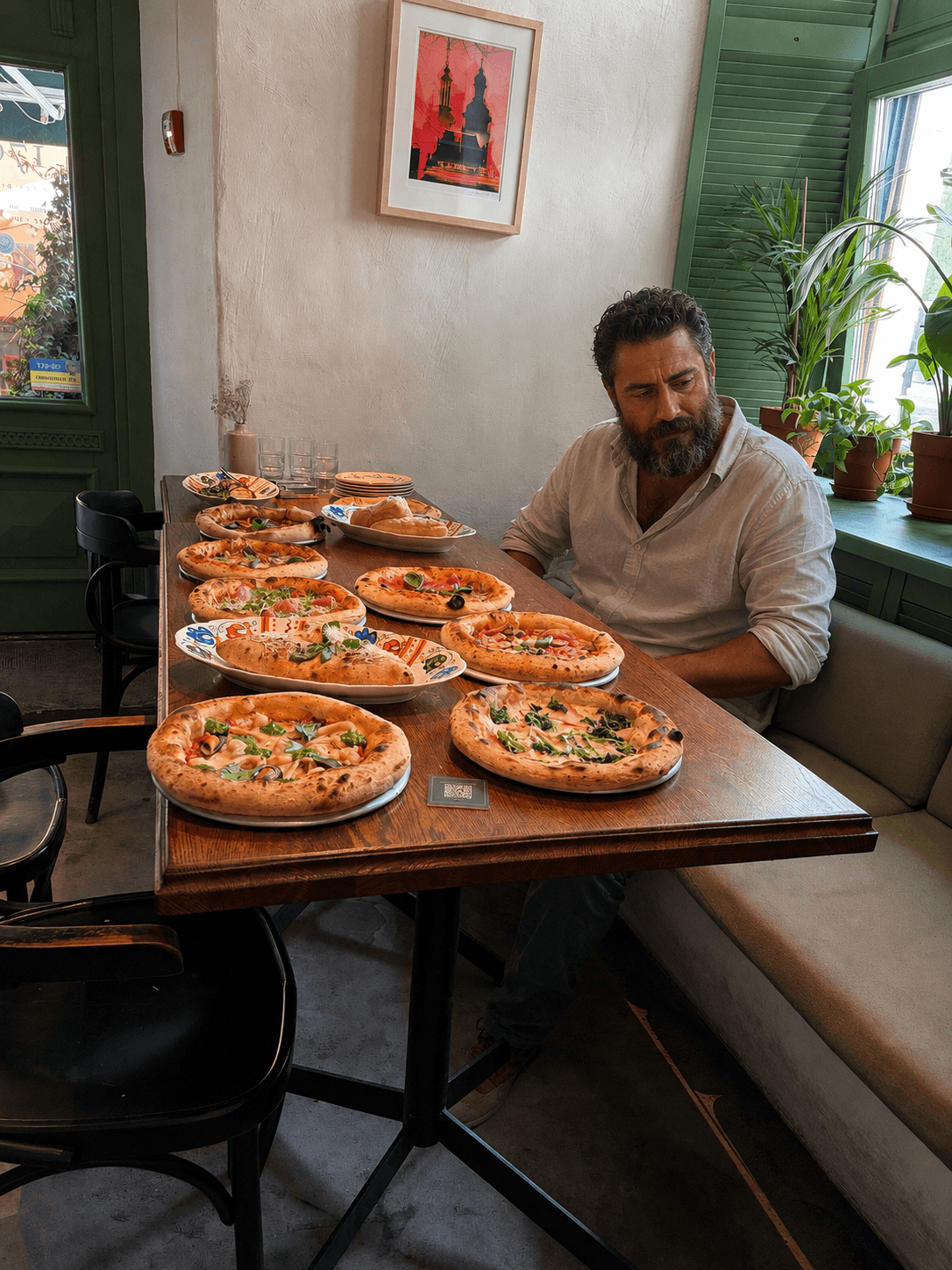
They were no longer all pepperoni.
One had mushrooms. Another had olives and artichokes. There was a green one involving basil and possibly optimism. A folded calzone appeared near the centre, although I objected that a calzone was not technically participating according to the original parameters.
The manager counted them twice.
“How many did you order?”
“One.”
“How many have you eaten?”
“Approximately half of one.”
He considered the table.
“So the balance is eight and a half.”
“That is not how anomalies work, but I admire your accounting.”
Another three appeared near the water glasses.
At this point, the long table had become a conference of pizzas. They overlapped on colourful plates, occupied the space intended for cutlery and advanced steadily toward my left elbow. The smell was magnificent. Tomato, toasted crust, basil, cheese and the faint aroma of a universe with no concern for carbohydrate limits.
I was confused.
But not, strictly speaking, unhappy.
There are worse anomalies.
Once in Porto, a hotel elevator refused to stop on any floor unless someone complimented its music. In Brno, a public fountain began returning lost umbrellas from entirely different centuries. Compared with those, multiplying pizza was almost hospitable.
I took out the Brama device and scanned the table.
It displayed:
LOCAL REPLICATION EVENT Source: uncertain Threat level: delicious Suggested action: reduce surplus matter
“Sensible device,” I said.
The manager leaned over my shoulder.
“Does it say why?”
“It rarely says why. It prefers to be useful after the interesting part.”
I conducted several experiments.
Moving a pizza to another table did not stop it.
Cutting one into slices made the slices multiply individually, which was a serious tactical error.
Putting a napkin over one caused three covered pizzas to appear. This proved that the anomaly understood comedy.
Then I noticed something.
A young man passing the open door had been staring at the table with the reverent expression usually reserved for miracles and free Wi-Fi.
I offered him a pizza.
He hesitated.
“For free?”
“Yes.”
“Why?”
“Structural maintenance.”
He accepted a mushroom pizza and walked away.
That pizza did not multiply.
Interesting.
I offered another to two students outside. They accepted it between them. No multiplication.
An elderly woman took a margherita after making me promise it was not part of a survey. A delivery courier accepted the spicy one and ate a slice while still standing beside his bicycle. A family with two children received the calzone, which the children correctly identified as “a pizza hiding something.”
Every pizza that was deliberately given to someone stopped reproducing.
The rule became clear: the anomaly multiplied food that had no recognised eater. The original pizza was mine, but every duplicate arrived without ownership, purpose or lunch appointment. Left unclaimed, it attempted to solve the problem by producing more candidates.
It was not a pizza anomaly.
It was an administrative anomaly.
Naturally, this made it far more dangerous.
The restaurant staff opened the door and began inviting passersby inside. I ate three pizzas—or possibly two and three-quarters, depending on whether we count the experimental slices. The manager ate one. The kitchen staff divided another. Pizzas went to tourists, shop workers, a street musician, a woman carrying flowers and a man who said he had only stepped outside to buy toothpaste.
Within twenty minutes, every pizza had been assigned.
The table was finally empty except for my original plate, several crumbs and one last pepperoni slice.
The slice shimmered.
I pointed at it immediately.
“That one is mine.”
It stopped.
The Brama device gave a satisfied beep and displayed:
SURPLUS MATTER RESOLVED Method: communal consumption Casualties: none Lunch duration: no longer quick
The waitress brought the bill.
It contained one small pepperoni pizza.
“What about the others?” I asked.
She glanced at the empty table.
“What others?”
Behind her, the manager slowly shook his head.
I paid for one pizza, left a considerably larger tip and walked back onto Krakivska Street carrying the final slice in a box. Outside, several complete strangers nodded to me with the warm solidarity of people who had unexpectedly received Neapolitan pizza in the middle of an ordinary afternoon.
The Clovis Institute later requested a formal explanation.
I wrote:
A limited replication field formed around an unassigned food item. The phenomenon was neutralised by establishing clear ownership through distributed consumption.
They replied:
You fed the pizzas to pedestrians.
Yes.
Science occasionally requires appetite, courage and a sufficient number of hungry passersby.
And that is how I went out for one small pizza and accidentally catered half of central Lviv.