The City That Polished Its Shadows
I had planned a calm Thursday.
That was my first mistake.
A calm Thursday is one of those phrases reality hears from across the room and takes personally. It is like saying, “At least the roof is not on fire,” while standing in a fireworks factory beside a nervous dragon.
The russians made certain I did not sleep late.
The missile alarms began during the night, followed by the familiar waiting: listening for engines, explosions, and the distant mechanical anger of air defence. They struck residential blocks once.
Then they struck them again.
I was safe. The windows held, the building remained where it had been placed, and nothing fell from the ceiling except a small amount of dust and whatever remained of my belief in a quiet morning. Other people were not so fortunate.
Assuming the russians had already done enough damage for one night was my second mistake.
By sunrise, the plan had become simpler. Coffee. Walk a little. Pretend I was a normal man with normal pockets and normal problems. Maybe buy something useless from a souvenir shop and convince myself it was “for research.” Then dinner somewhere in Lviv where the walls are older than most governments and considerably more honest.
Instead, at 09:42, my Brama device began vibrating on the bedside table.
Not ringing.
Vibrating.
That was worse.
A ring means someone wants to talk. A vibration means someone has decided I need to be involved before I have trousers.
The message was from an old friend in Azuma.
His name is Elias Varo, attorney at law, licensed in twelve jurisdictions, three realities, and one city-state that no longer exists because of a disagreement about whether Tuesday should be taxable.
Elias is the sort of lawyer who can make a contract sound like poetry, a threat sound like a weather report, and a disaster sound like a scheduling inconvenience. He once got me out of an Azuman customs hearing after I accidentally entered the city carrying a folded seventeenth-century map that had become legally alive somewhere near Corridor B. It kept testifying against me.
He saved me from six months of bureaucratic hospitality, which in Azuma means a luxury room, excellent food, and a polite AI asking every morning if you are ready to admit you are guilty of importing cartographic consciousness without declaration.
So when Elias wrote, “Marco, I need you in Azuma now. Do not reply. Come alone,” I went.
I suggested meeting at his apartment.
He replied immediately.
“No. Public place.”
That was not Elias.
Elias loved his apartment. It overlooked the western bay of Azuma, where the sea reflected the upper towers so perfectly that you sometimes forgot which city was real and which one was upside down. His home had floor-to-ceiling glass, a kitchen that could make soup based on your emotional state, and a balcony garden where the plants rearranged themselves according to civil law precedents.
If Elias did not want to meet there, something was wrong.
If Elias wanted a public place, something was very wrong.
Azuma does not look like a city so much as a promise someone made while holding unlimited funding and excellent taste.
The first time you arrive, you feel annoyed at your own Earth for not trying harder.
Its towers rise from a vast silver-blue bay in interlocking spires of glass, steel, ceramic light, and living greenery. Floating platforms drift between districts like quiet islands. Sky-trams move without noise along invisible routes. Rooftop farms glow in neat geometric terraces. Parks run through the city not as decoration, but as arteries, full of water mirrors, soft grass, and trees whose leaves shimmer faintly when the transit system passes beneath them.
At twilight, Azuma becomes almost unfair.
The bioluminescent gardens come alive in soft indigo and green. The water mirrors catch the light from the towers. Holographic notices bloom in the air, announcing concerts, debates, museum openings, philosophy festivals, diplomatic tastings, and one public lecture titled: “Was Gravity Always This Opinionated?”
People from countless realities walk the avenues. Humans in elegant coats. Sentient AI avatars wearing bodies made of light. Crystalline beings who communicate by tinting their edges. Tiny mechanical monks. Tall blue-skinned diplomats. Someone shaped like a copper umbrella who was buying pastries with great seriousness.
Everything works.
That is the unsettling part.
Doors open. Trains arrive. Payments happen with a flicker of Aero Credits, the little loop symbol appearing on glass counters like magic that has hired accountants. The streets are clean without feeling sterile. The parks are full without feeling crowded. Even the pigeons seem to understand zoning regulations.
And yet Azuma has always had shadows.
Not dirt. Not decay. Shadows.
The kind that gather behind polished surfaces. The kind that make mirrored corridors feel one second too long. The kind that make you notice a security camera turning toward you after you have already looked away.
Elias chose Cloud 9 Café, in the central district, just above the old transit hub and beneath a suspended garden platform.
The café was built into the side of a tower, but it opened onto air. Not open air exactly. Azuman engineers dislike choosing between indoors and outdoors, so they had created something in between. Transparent walls curved around the terrace. Soft clouds of mist drifted beneath the glass floor. Far below, sky-trams crossed the city like silver fish.
Inside, the place was warm with pale wood, brass rails, cream ceramic counters, and hanging gardens that grew downward from the ceiling in slow spirals. The tables were made of some translucent stone with tiny points of light moving inside, like stars trying to remember where they belonged. A pianist, possibly human and possibly not, played something quiet on a white instrument with no strings.
The coffee arrived in cups that looked handmade but definitely were not. Azuma likes to simulate imperfection with military precision.
I ordered dark roast filter coffee because I am a man of culture and also because I do not trust drinks that require a licensing exam.
Elias had already ordered food. That worried me too.
He was usually too organized to order before everyone arrived.
There were small plates of cloudbread with salted butter, roasted bay mushrooms glazed with citrus oil, eggs folded around green herbs and tiny gold potatoes, and a bowl of something the server called morning broth, which tasted like chicken soup that had gone to university and come back with expensive opinions.
There were also sweet crystal pears sliced paper-thin, warm honey cakes, and a small dish of black salt that hummed faintly when touched.
“Do not touch that,” Elias said.
So naturally I almost touched it.
He looked terrible.
Elias Varo had always been immaculate. Silver-black hair brushed back. Dark suit. Perfect cuffs. Polished shoes. Calm face. A man who could walk through a riot and leave with both sides apologizing for the noise.
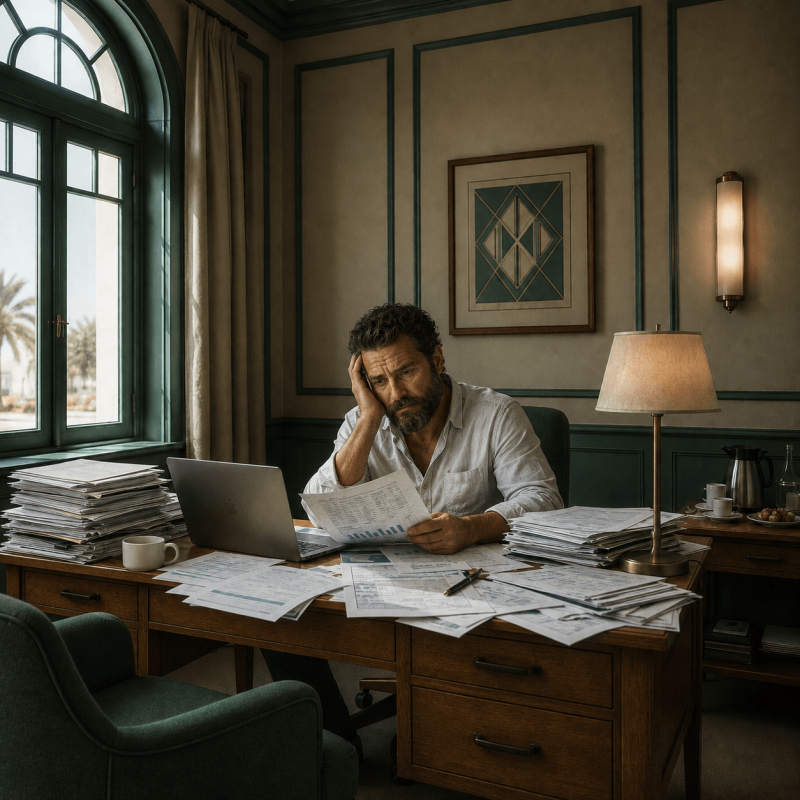
Now his collar was uneven. His eyes were red. His hands shook when he lifted his coffee. There was a stain on one sleeve, and not an artistic one. His beard had grown in badly, as if even his face had given up on procedure.
He kept looking behind me.
Then at the ceiling.
Then at the reflection in his spoon.
“Elias,” I said gently. “You look like a man who has either discovered the end of the world or tried to assemble furniture from the Emporium without instructions.”
He did not smile.
That frightened me more than anything.
“You still joke when afraid,” he said.
“Professional habit.”
“You should stop.”
“Many people have suggested that. Most of them are dead, retired, or running theme restaurants.”
He leaned closer.
“Marco, have you ever heard of the Pattern?”
I looked at him for a moment.
Outside the transparent wall, Azuma shone in the morning light like civilization had finally filed its paperwork correctly.
“The Pattern,” I repeated.
“It is not a code,” he said. “That is the first mistake everyone makes. It is not a god either. The cults are wrong. The mathematics departments are wrong. The corporations are very wrong.”
“Good. I was worried the corporations might be right for once.”
He ignored that.
“It is what reality does when no one is looking.”
That line sat between us like a cold coin.
Elias opened his bag and placed five objects on the table.
A rusted pocket watch with no hands.
A cracked teacup, its rim full of old sand.
A weathered wooden toy horse, one leg shorter than the others.
A tattered leather-bound book with blank pages.
A frayed scarf, sun-faded almost white.
I stared at them.
The café noise softened. Not stopped. Softened. As if the room had politely moved farther away.
“Souvenirs?” I asked.
“Artifacts.”
“They look like flea market sadness.”
“They were bought at five different multiversal markets, in five unrelated districts, by five unrelated people, over eight years.”
“And?”
“And every owner died on a Thursday.”
I looked at him.
He looked back.
“Do not say it,” he said.
“I was going to say Thursday is statistically suspicious.”
“No, you were going to make a joke about weekends.”
“I was choosing between two.”
He rubbed his face.
“The Pattern appears across worlds, Marco. Not as one event, but as repetition. Triangles in urban plans. The number 1884 appearing in court archives, train schedules, birth records, door codes, missing person files. People with the same scar born in fifty realities with no genetic connection. Animals staring into cameras at the same second across timelines. Songs forgotten in one world and remembered in another by children who could never have heard them.”
The pocket watch ticked.
It had no hands.
That was rude.
“Elias,” I said slowly, “why are you telling me this?”
“Because Azuma has found a Pattern cluster.”
“Found by whom?”
He swallowed.
“That is the problem.”
Outside, a platform moved between towers, casting a long shadow across the café. For a moment, the bright room dimmed. Elias flinched.
“Three major corporations discovered pieces of it independently,” he said. “Then a guild in the Underlevels. Then the Museum. Then a civic planning AI noticed old city maps were arranging themselves into triangles that had not been there before.”
“Maps do not usually edit themselves.”
“In Azuma they sometimes do, but they file a notice first.”
I nodded. “Reasonable city.”
He pushed the blank book toward me.
“Open it.”
“I hate when people say that.”
“Open it.”
I did.
The pages were blank.
Then, very slowly, words appeared.
Not written in ink.
Pressed into the paper, as if the language had always been there and was only now becoming embarrassed enough to show itself.
Under that, a triangle.
Under that, my name.
I closed the book.
“That is impolite,” I said.
Elias whispered, “It knows you.”
“Nothing knows me. Some things have strong opinions.”
“No, Marco. Listen. There are cases across dimensions. Old disappearances. Fires. Accidents. Wars that began after harmless combinations of objects were placed together. Families repeating the same tragedy on worlds that never contacted each other. The Pattern does not think, but it behaves like something alive. It corrects. It echoes. It pulls.”
“Pulls what?”
“People.”
The word was barely audible.
Then he looked toward the café’s rear corridor.
“I need a minute.”
“No,” I said at once.
He blinked.
“I am going to the toilet, Marco.”
“Take the watch.”
“What?”
“Or I come with you.”
“You cannot come with me to the toilet.”
“I have been to stranger places with worse acoustics.”
For one second, almost one beautiful second, he smiled.
There was my friend.
Then the smile vanished.
“Stay here,” he said. “Watch the objects. If I do not return in five minutes, take them to Clovis. Not to Azuma authorities. Not to the Museum. Not to anyone here.”
“Elias.”
“Five minutes.”
He stood and walked toward the corridor.
The café continued.
Coffee machines whispered. Cups clicked. A woman made of amber glass laughed at something on her holo-screen. A small child pointed at a sky-tram. The pianist changed key.
Three minutes passed.
Four.
At four minutes and thirty seconds, the lights flickered.
Not enough for panic.
Enough for me.
I was on my feet before the fifth minute.
The rear corridor was lined with mirrored panels and soft green plants growing from vertical channels. The toilet doors were exactly where they should be.
One for men.
One for women.
One for species requiring atmospheric assistance.
One marked “variable,” which I chose not to think about.
No Elias.
I checked the men’s room first. Empty. Too clean. Smelled faintly of rain and expensive soap.
There was a window that should not have opened. It did not open.
There were no vents large enough for a person. No ceiling panel out of place. No blood. No sign of struggle.
Only one thing.
On the mirror, written in condensation though the room was dry, was the number 1884.
Then it vanished.
When I returned to the table, the objects were gone.
So was Elias’s cup.
Only the black salt remained, humming softly.
I did not touch it.
I am maturing.
Azuma police arrived in under two minutes, which is impressive unless you consider the possibility that they were already watching.
They wore white and graphite uniforms with thin gold lines at the cuffs. Their badges were not badges but small floating seals beside their shoulders, each displaying name, rank, jurisdiction, and a polite summary of their authority. Very convenient. Very terrifying.
The lead officer was a woman named Captain Sera Malk. Tall, calm, perfect posture, eyes like someone had taught ice to judge.
She asked questions.
I answered.
Mostly.
When I mentioned Clovis, her expression changed by one millimeter. In Azuma, that is equivalent to screaming.
“This is an Azuman matter,” she said.
“He is my friend.”
“He is an Azuman citizen.”
“He called me.”
“That was unfortunate.”
I looked at her.
“Captain, a man vanished from a café toilet, five objects disappeared from a table, a blank book wrote my name, and your city is currently doing that thing where it pretends everything is fine because the glass is clean.”
Her jaw tightened.
“Mr. Marco, Azuma is one of the most advanced civil societies in the known interdimensional network.”
“Oh good. I was worried the sky-trams were decorative.”
“We have investigative systems beyond the reach of your world.”
“My world has three coffee shops on one street and still cannot agree where the queue begins. This is not news.”
“You should return home.”
“I would rather stay.”
“That is not a request.”
Around us, the café had gone quiet in that very civilized way where everyone pretends not to listen while storing details for later.
Captain Malk stepped closer.
“You have a reputation,” she said. “A vague one. A noisy one. But you are not licensed here. You are not trained in our legal environment. You do not understand our infrastructure, our social systems, or our threat architecture.”
“Threat architecture,” I repeated. “That is a beautiful phrase. Did the building design the kidnapping itself?”
Her eyes narrowed.
“You are a visitor from a less developed reality carrying outdated assumptions and an inflated sense of relevance.”
That was almost charming.
Almost.
You must understand, dear reader, that this happens often.
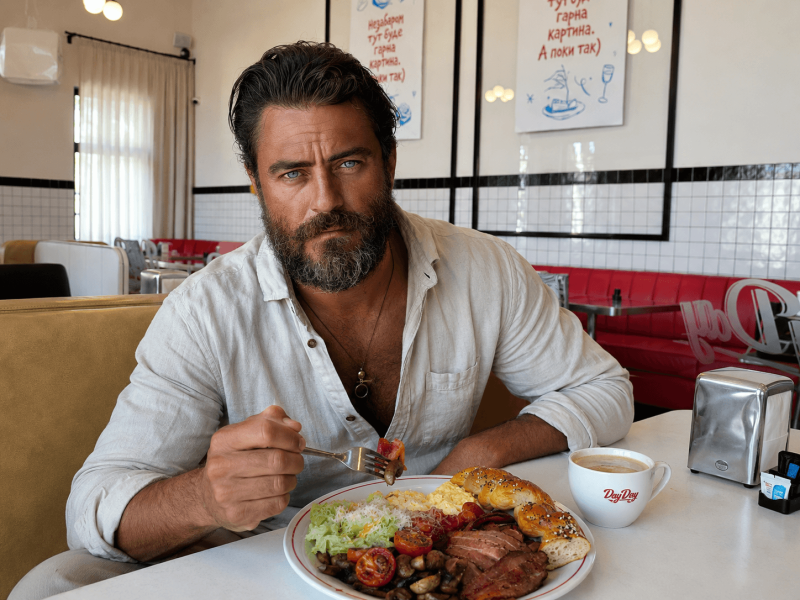
People meet me and see a big man in a coat who drinks too much coffee, asks inconvenient questions, and looks like he might know how to fix a door by hitting it.
This is not entirely wrong.
But it is incomplete.
They do not know about the gates. They do not know about the worlds that burned. They do not know about the civilizations that erased themselves so thoroughly that even their ruins forgot their names. They do not know how many times I have died in rooms that looked perfectly safe. They do not know that some things follow laws older than their laws, and some shadows do not care how advanced your public transport is.
They do not know me in detail.
Which is sometimes useful.
And sometimes deeply irritating.
Captain Malk escorted me personally to the transit hub. Not physically, of course. Azuma is too elegant for that. She simply walked beside me with two drones and three silent officers, creating a moving suggestion that I should not explore alternative routes.
At the portal gate, she said, “We will contact your Institute if needed.”
“No, you will not.”
She paused.
I smiled.
“You will contact them if the Pattern lets you.”
For the first time, she looked uncertain.
Only for a second.
Then the portal opened, and Azuma’s shining towers folded into white light.
I came back to Lviv in the evening.
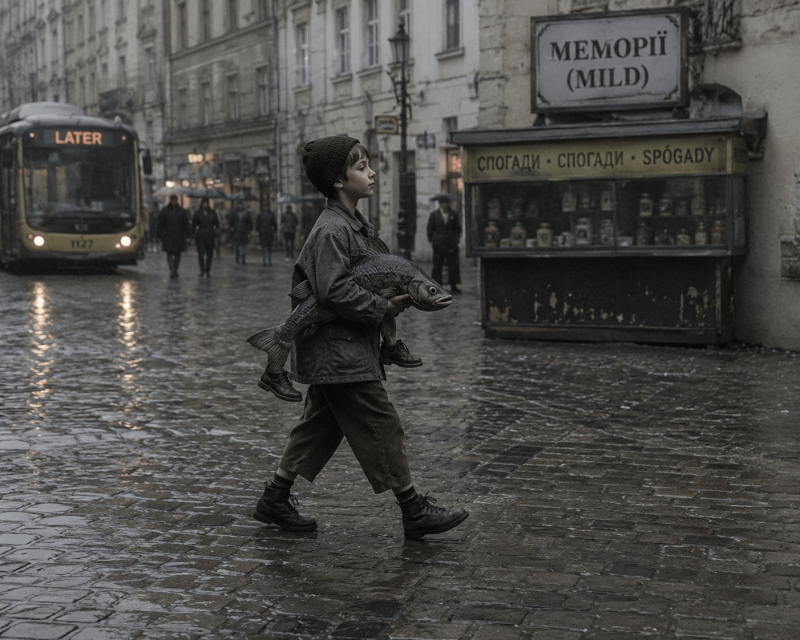
The city felt old, solid, imperfect, and mercifully honest. Wet stones. Yellow lamps. People walking under coats. The smell of food and rain and wood smoke. No floating platforms. No polite drones. No architecture with a superiority complex.
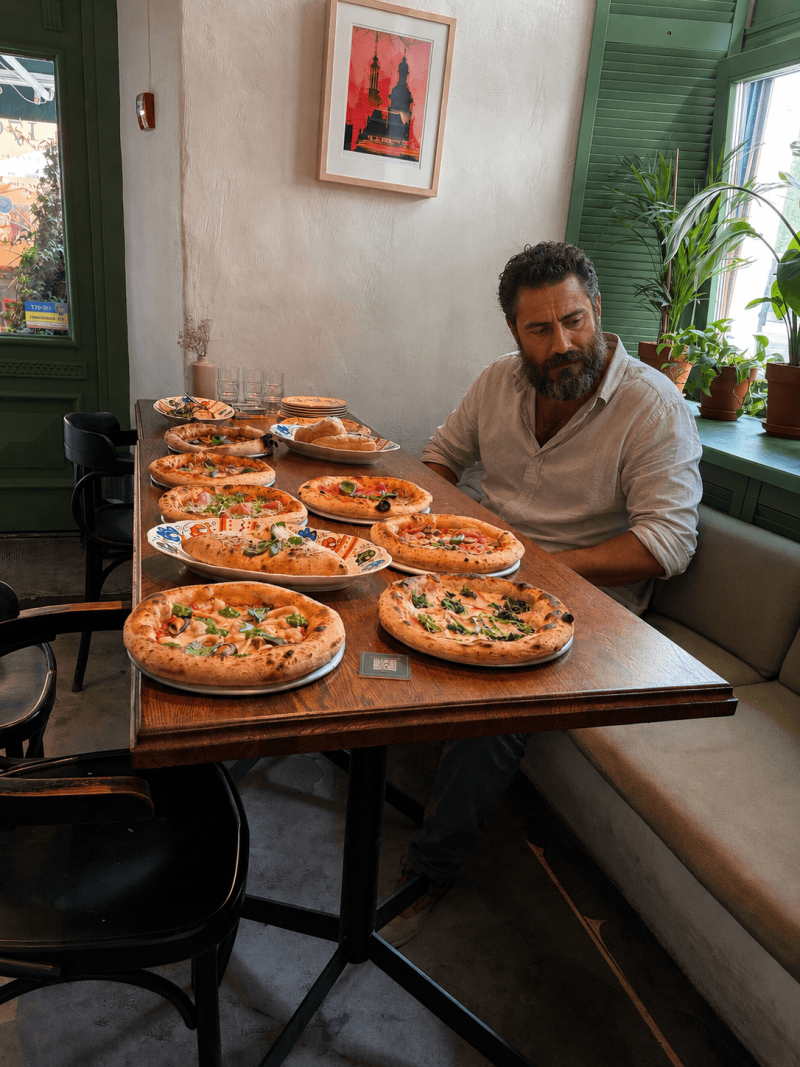
I went to Kryivka for dinner because sometimes, after being insulted by a hyper-advanced metropolis, a man needs meat, potatoes, and walls that look like they have survived history by headbutting it.
I ordered properly.
Borshch. Varenyky. Meat. Something pickled. Something that may have been stronger than legally advisable. Bread with garlic. Coffee afterward, because I am not a savage.
Then, between bites, I wrote the report for Clovis.
Subject: Disappearance of Elias Varo, Azuma. Possible Pattern cluster. Objects involved: pocket watch without hands, cracked teacup with sand, wooden toy horse, blank book, faded scarf. Number recurrence: 1884. Local authorities obstructive, proud, probably frightened. Recommend quiet investigation. Do not trust Azuman official channels until verified. Do not place similar objects together. Do not let the book see my name again.
I stared at that last line for a while.
Then I added:
If anyone finds Elias, tell him he still owes me breakfast. Also tell him he was right. Public place was not enough.
Outside, Lviv moved through Thursday night with its usual mixture of beauty, exhaustion, and stubborn life.
Somewhere far away, Azuma shone over its perfect bay.
Somewhere beneath all that light, the shadows were arranging themselves into triangles.
And for the first time in a long while, I had the uncomfortable feeling that reality was not breaking.
It was remembering a shape.